New vs Old Tax Regime Calculator 2026-27
Compare tax liability under both regimes with your exact income and deductions.
Read the complete guideOld Regime Deductions
New regime saves you
₹89,700
per year
| New Regime | Old Regime | |
|---|---|---|
| Gross Income | ₹15,00,000 | ₹15,00,000 |
| Standard Deduction | -₹75,000 | -₹50,000 |
| Other Deductions | Not allowed | -₹2,25,000 |
| Taxable Income | ₹14,25,000 | ₹12,25,000 |
| Tax (before rebate) | ₹93,750 | ₹1,80,000 |
| Cess (4%) | ₹3,750 | ₹7,200 |
| Total Tax | ₹97,500 | ₹1,87,200 |
| Effective Tax Rate | 6.84% | 15.28% |
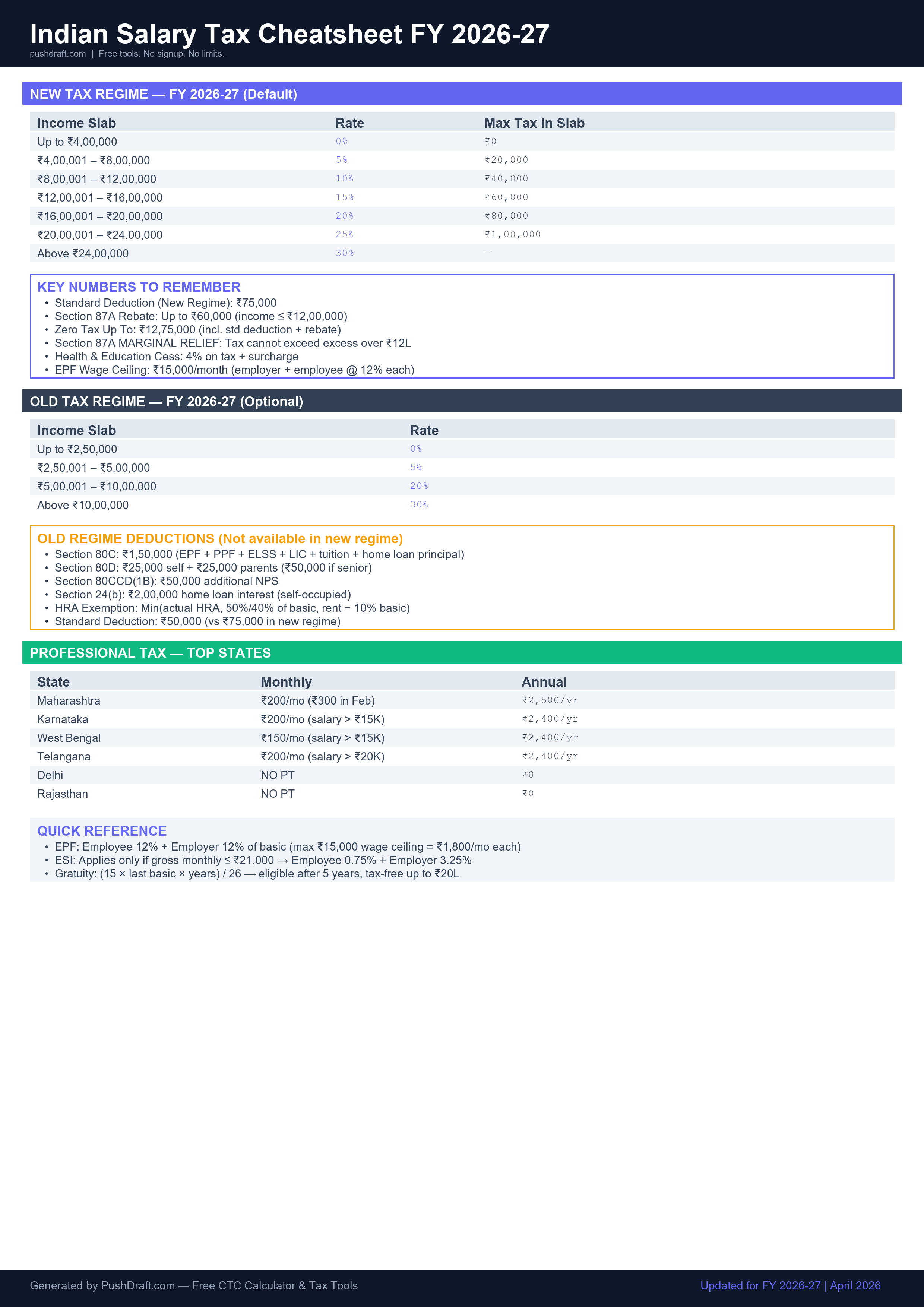
Free: Indian Salary Tax Cheatsheet 2026-27
New regime slabs, old regime deductions, PT by state — one page, print-ready.
How to Use Tax Regime Comparison
-
Enter annual gross income
Total income from salary before any deductions.
-
Enter deductions (old regime)
Add 80C (up to 1.5L), 80D health insurance, HRA, home loan interest, NPS.
-
Compare results
See tax under both regimes side by side with the exact savings amount.
Related Tools
Frequently Asked Questions
What changed in the new tax regime for 2026-27?
The Union Budget 2026-27 retained all income tax slabs unchanged. Under the new regime, income up to Rs 12 lakh is effectively tax-free (after Rs 75,000 standard deduction and Section 87A rebate). The new Income Tax Act 2025 took effect from April 1, 2026.
Can I switch between old and new regime every year?
Yes, salaried employees can switch between old and new tax regimes every financial year when filing their ITR. You are not locked in permanently. However, business income taxpayers can only switch once.
PushDraft Weekly
Get weekly salary tips, tax updates, and new tools. Free, no spam, unsubscribe anytime.